Post-Occupancy Lessons from the NCBS Laboratory Design
A reflective account of designing a pioneering research laboratory for National Centre for Biological Sciences in 2006, highlighting key design successes and critical lessons learned through post-occupancy feedback from researchers.
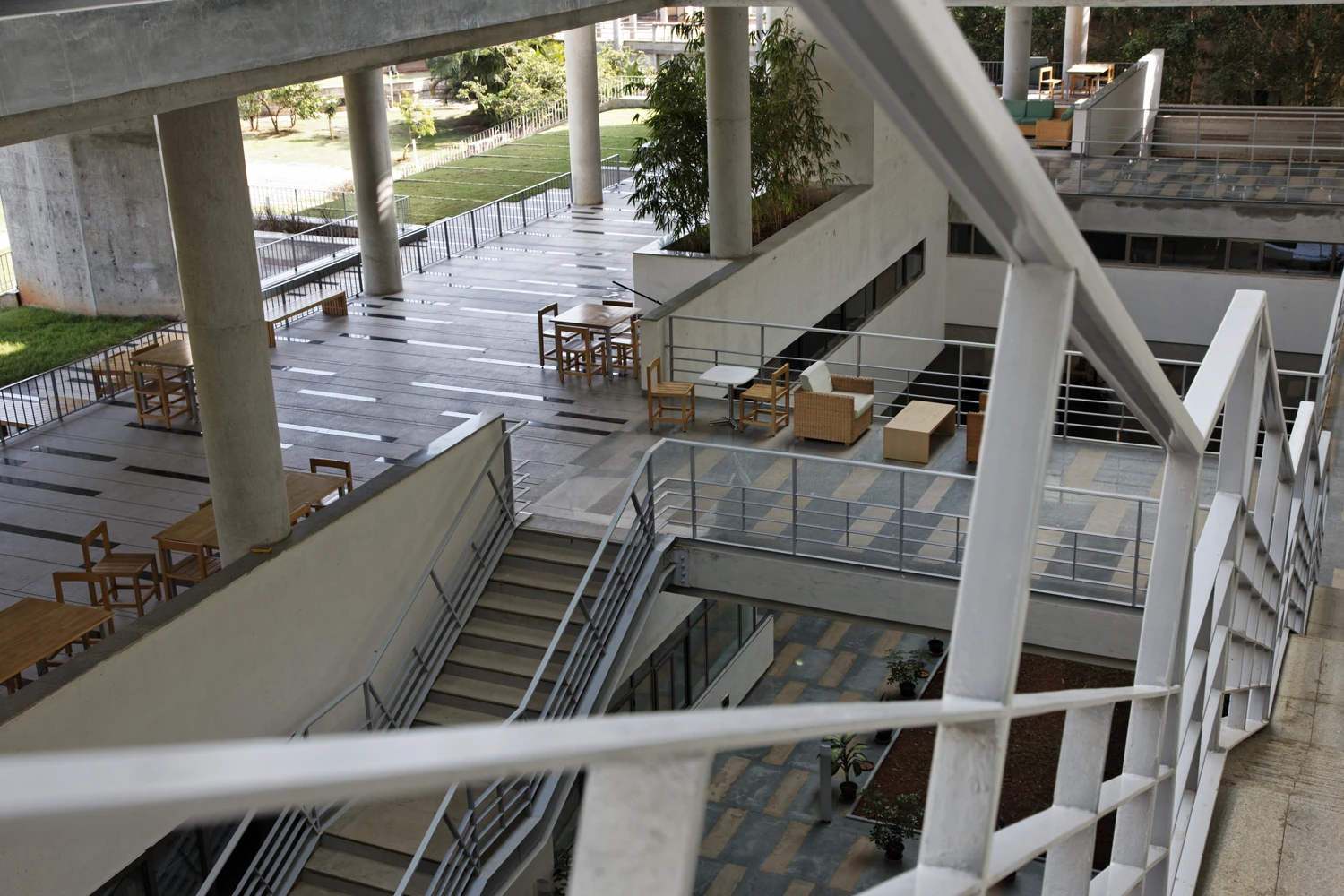
In 2006, we built a laboratory that India had never seen before. When National Centre for Biological Sciences approached us through an invited competition, neither we nor most firms in India had designed a research facility of this scale. That gap was precisely what Tata Institute of Fundamental Research wanted to address.
The brief was unusually clear: not just a building, but a new typology - flexible, modular, and capable of fostering cross-disciplinary interaction.
Three core ideas drove the design:
Interstitial service floors between lab levels, allowing maintenance and upgrades without disrupting research.
Double-height glazed facades with PI offices overlooking lab benches, making science visible and collaborative.
A campus structured around a central maidan with stepped ghats, encouraging informal interactions beyond the lab.
Years later, we conducted a post-occupancy survey with researchers working in the building. The findings were revealing.
The building performed well overall. Over 84% of respondents reported feeling productive and energetic. The open lab layout - our boldest move - received the highest ratings, with nearly 58% giving it a perfect score. Interstitial service floors were also validated, with over 68% finding them genuinely useful.
However, two critical shortcomings emerged.
Privacy scored the lowest. More than 36% rated it 1 out of 5. While openness fostered collaboration, it hindered focus. As one researcher noted, "there is a constant disturbance." We realized that openness and concentration are distinct needs. The takeaway: open labs require a gradient of spaces - from collaborative to contemplative - within the same floor.
Connection to the outdoors was also weaker than expected. Only 42% rated it highly, despite the glazed facades and central maidan. Ironically, the colonnade - an in-between space - was the most loved feature, described as calming and visually engaging. The lesson: research environments need deeper integration with nature through permeable thresholds, outdoor workspaces, and planted edges.
This project fundamentally shaped how we think about research environments. We are proud of what it achieved - and equally grateful for what it taught us.
As India expands its research infrastructure, these conversations around flexibility, interaction, privacy, and human-centered design are more relevant than ever.